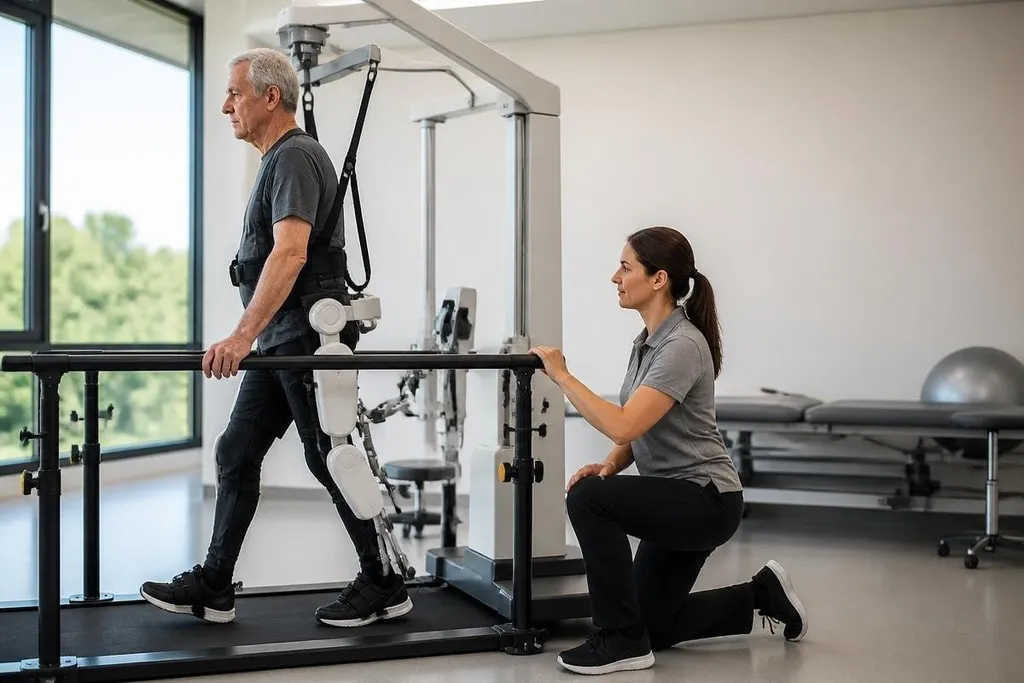
A rehabilitation robot can guide a leg, support a body, or measure movement during an exercise. Its future will depend on how well it fits the short, busy therapy hour, not on how human-like the machine looks.
- Robots will adjust help as a patient gets stronger.
- Force sensors and joint-angle data will shape each exercise.
- Clinics will still need clear proof that the machines help patients recover.
The useful work is in the adjustment
Most rehabilitation robots work by controlling movement while a person takes part in the task. An exoskeleton can support a knee or hip, while a robot arm can guide a hand through repeated motions.
The next step is finer control of that support. A system could give more help when a patient loses balance, then reduce help after the same movement becomes easier. That change matters because therapy should follow the person’s ability from one session to the next.
Force sensors can measure how hard a patient pushes against a handle or footplate. Joint-angle encoders can record how far a limb moves. A controller can use those signals to adjust motor force during the exercise, rather than relying on one fixed setting.
The machine still needs limits. A patient may move slowly because of pain, weakness, fear, or poor balance. A robot that reads slow movement as a simple lack of strength could give the wrong kind of help.
Data will shape the session
Rehabilitation robots can collect movement data during each exercise. That may include joint angle, force, step timing, range of motion, and the number of completed repetitions.
Those measures could help a therapist see small changes that are hard to judge by sight alone. They could also show when a patient has reached the point where an exercise needs more resistance or less robotic support.
Data does not replace a therapist’s judgment. A person may complete 20 repetitions while using poor posture, holding their breath, or hiding pain. The robot can record the movement, but a clinician still needs to decide what the movement means.
A dated rehabilitation robot report from Robot24.com can show whether a system measures posture and recovery time in a clinic rather than during a staged demo.
The clinic sets the limits
A rehabilitation robot has to fit through doors, leave room for a wheelchair, and start without a long setup. The therapist also needs a clear way to change the task, stop the motors, and remove the patient from the machine.
Training will shape adoption too. Staff need to know how the robot reacts when a sensor loses its signal, a patient shifts position, or a motor reaches its force limit. Those cases should be part of routine training, not left to a service visit.
Cost will matter in a direct way. A clinic may compare the purchase price with staff time, maintenance, cleaning, software fees, and the number of patients who can use the machine in a week. A robot that needs a specialist for every session may fit a research center better than a busy outpatient clinic.
The strongest opposing view is that a robot can give patients more repeated practice than a therapist can give one person alone. That may be useful, but repetition only helps when the movement is suited to the patient and watched for signs of pain or fatigue.
What remains unproven
The field still needs clear answers about long-term recovery, cost per patient, and which patients gain the most from robotic help. A smooth demo can show that a robot completes a movement. It cannot show that the movement leads to better daily function months later.
Future systems may connect exercise records across visits, adjust support after each session, and work with wearable sensors. Those features could make treatment more consistent.
They also raise questions about data storage, device failure, and who checks an automated decision.
I'd skip any system whose maker cannot explain the task, the safety stop, and the evidence behind its treatment claims.
A clinic buyer’s checklist
Before a clinic buys a rehabilitation robot, check these points:
- Patient fit: Which conditions and movement limits can the system handle?
- Therapist control: Can staff change force, speed, range, and repetition targets?
- Safety response: What happens after a sensor fault, loss of balance, or emergency stop?
- Daily setup: How long does fitting take, and can one staff member do it?
- Useful records: Can the system export force, joint angle, step timing, and session data?
- Full cost: What do maintenance, software, training, and cleaning add each year?
The next phase of rehabilitation robotics will be decided in ordinary clinics, one therapy hour at a time. Machines that fit that work and show lasting patient gains will earn wider use; the rest will remain expensive equipment waiting for better proof.